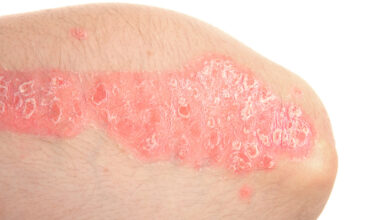
Psoriasis is a chronic, immune-mediated skin disorder characterized by the rapid proliferation and abnormal differentiation of keratinocytes (skin cells), leading to the development of thickened, scaly, and erythematous plaques on the skin’s surface. It is a multifactorial condition influenced by genetic predisposition, environmental triggers, and immune system dysregulation. The underlying pathology involves an overactive immune response, particularly involving T-helper cells and pro-inflammatory cytokines such as tumor necrosis factor-alpha (TNF-α), interleukin-17 (IL-17), and interleukin-23 (IL-23), which promote inflammation and stimulate excessive skin cell growth. Clinically, psoriasis manifests in various forms, with plaque psoriasis being the most common, often presenting as well-defined, silvery-scaled lesions predominantly on the elbows, knees, scalp, and lower back. The disease can significantly impact quality of life due to its chronic nature, visible skin changes, and associated symptoms such as itching and discomfort. Although psoriasis primarily affects the skin, it is also associated with systemic comorbidities, including psoriatic arthritis, cardiovascular disease, and metabolic syndrome, highlighting its multisystem involvement. Treatment options vary depending on the severity and location of the disease.
Topical agents
Topical agents remain a cornerstone in the treatment of psoriasis, particularly for mild to moderate cases, due to their direct action on lesions and minimal systemic side effects. Corticosteroids are the most commonly used topical treatments; they reduce inflammation by inhibiting pro-inflammatory cytokines and are effective in decreasing plaque formation. The efficacy varies with the potency of the steroid, and while they provide rapid relief, long-term use can lead to skin thinning and tachyphylaxis. Vitamin D analogs, such as calcipotriene, work by inhibiting keratinocyte proliferation and modulating immune responses, often used in combination with corticosteroids to enhance effectiveness and reduce side effects. Topical retinoids like tazarotene normalize skin cell growth and serve as adjunctive therapy. Calcineurin inhibitors, including tacrolimus and pimecrolimus, are useful for sensitive areas like the face and groin, offering an anti-inflammatory effect without the risk of skin atrophy. Coal tar and anthralin are traditional agents that reduce scaling and slow cell growth, though their use is limited by odor and staining. The choice of topical therapy depends on factors like lesion location, severity, and patient preference, with combination treatments often providing superior results. Overall, topical agents are effective in managing localized psoriasis, improving symptoms with adherence and proper application.
UV phototherapy
Phototherapy in the form of sunlight has long been used for psoriasis. UVB wavelengths of 311to 313 nanometers are most common. UV-B lamps have been developed for this treatment. The exposure time should be controlled to avoid overexposure and burning of the skin. The UVB lamps should have a timer that turns off the lamp when the time ends. The dose is increased in every treatment to let the skin get used to the light. Increased rates of cancer from treatment appear to be small. Narrowband UVB (NB-UVB) therapy has been demonstrated to have similar efficacy to psoralen and ultraviolet A phototherapy (PUVA). A meta-analysis found no difference in efficacy between NB-UVB and PUVA in the treatment of psoriasis, but NB-UVB is usually more convenient.
UV phototherapy, particularly narrowband ultraviolet B (NB-UVB), is a well-established and effective treatment modality for moderate to severe psoriasis, especially when topical therapies are insufficient or impractical. Its efficacy stems from its ability to modulate the immune response by inducing apoptosis (cell death) of pathogenic T-cells in the skin, reducing inflammatory cytokine production, and normalizing keratinocyte (skin cell) proliferation. NB-UVB therapy has demonstrated rapid improvement in psoriasis plaque severity, with many patients experiencing significant clearance or marked reduction in lesion thickness and scaling after several weeks of treatment. The treatment’s outcomes are often sustained with regular sessions, and it offers a favorable safety profile compared to systemic therapies, with minimal risks of systemic adverse effects. However, its efficacy can vary depending on factors such as the extent and location of disease, patient adherence to the treatment schedule, and individual skin sensitivity. Light-based therapy also carries potential side effects, including transient erythema, dryness, and in some cases, an increased risk of photoaging or skin carcinogenesis with long-term or high-dose exposure. Despite this, UV phototherapy remains a valuable option for patients with extensive or resistant psoriasis, providing significant symptomatic relief and improving quality of life.
PUVA combines the oral or topical administration of psoralen with exposure to ultraviolet A (UVA) light. The mechanism of action of PUVA is unknown but probably involves activation of psoralen by UVA light, which inhibits the abnormally rapid production of cells in psoriatic skin. There are multiple mechanisms of action associated with PUVA, including effects on the skin’s immune system. PUVA is associated with nausea, headache, fatigue, burning, and itching. Long-term treatment is associated with squamous cell carcinoma (but not with melanoma). A combination therapy for moderate to severe psoriasis using PUVA plus acitretin, an oral retinoid drug, resulted in benefit, but acitretin use has been associated with bitht defects and liver damage.
Systemic Therapy
Non-biologic systemic therapies are an important component in the management of moderate to severe psoriasis, especially for patients who have not responded adequately to topical treatments or phototherapy. These agents work by suppressing or modulating the immune response that drives the hyperproliferation of keratinocytes characteristic of psoriasis. Methotrexate is one of the most widely used non-biologic therapies, exerting its effect by inhibiting dihydrofolate reductase, which reduces DNA synthesis and suppresses rapidly dividing T-cells and keratinocytes. It has proven efficacy in reducing psoriatic severity and improving skin lesions, often with rapid onset of action. However, methotrexate requires regular monitoring due to potential hepatotoxicity, bone marrow suppression, and gastrointestinal side effects. Acitretin, a systemic retinoid, normalizes keratinocyte differentiation and proliferation, making it particularly useful in pustular and erythrodermic psoriasis. Its efficacy depends on continuous use, but its teratogenicity limits its application in women of reproductive age. Cyclosporine, another potent immunosuppressant, acts by inhibiting T-cell activation and cytokine release, often providing rapid and significant improvement, especially in acute or severe cases. Nonetheless, its use is limited by potential nephrotoxicity, hypertension, and risk of secondary malignancies with long-term use. Apremilast, an oral phosphodiesterase-4 inhibitor, offers a different mechanism by reducing inflammatory cytokines and has shown moderate efficacy with a favorable safety profile, making it suitable for patients with comorbidities. Overall, non-biologic systemic therapies provide effective options for controlling psoriasis severity, but their use requires careful assessment of benefits versus potential adverse effects, and ongoing monitoring is essential for safe and effective long-term management.
Biologic systemic therapies have revolutionized the treatment of moderate to severe psoriasis by targeting specific components of the immune system involved in its pathogenesis. These agents, primarily monoclonal antibodies, inhibit cytokines such as tumor necrosis factor-alpha (TNF-α), interleukin-17 (IL-17), and interleukin-23 (IL-23), which play crucial roles in promoting inflammation and keratinocyte hyperproliferation. Anti-TNF agents like etanercept, infliximab, and adalimumab have demonstrated significant and rapid improvements in skin clearance by reducing systemic and local inflammation. More recently, IL-17 inhibitors such as secukinumab, ixekizumab, and brodalumab have shown higher efficacy in achieving clear or near-clear skin, owing to their direct inhibition of pathways involved in keratinocyte proliferation and immune response. Similarly, interleukin 23 IL-23 inhibitors like guselkumab, tildrakizumab, and risankizumab target upstream cytokines that drive the helper T cell, Th17 cell activity, leading to sustained remission and longer dosing intervals. These biologics are generally well tolerated, with most patients experiencing minimal side effects; however, they do carry risks including increased susceptibility to infections, reactivation of latent tuberculosis, and rare cases of malignancy. Their targeted mechanism allows for effective disease control with fewer adverse effects compared to traditional systemic agents, making them especially valuable for patients with extensive disease or those who have failed conventional therapies. Nonetheless, their high cost, the requirement for injection administration, and long-term safety considerations necessitate careful patient selection, monitoring, and individualized treatment planning to optimize outcomes.